Jiangmen Lawyers Association Holds 2026 Criminal Defense Training
On April 27, 2026, the Jiangmen Lawyers Association held a specialized criminal defense training for nearly a hundred young lawyers, focusing on first- and second-instance practice. Lawyer Huo Jun was among the keynote speakers.

To continuously enhance the professional criminal defense capabilities of the city's lawyers, standardize criminal defense practice, and strengthen risk-prevention awareness, a specialized criminal defense training hosted by the Jiangmen Lawyers Association was successfully held on the afternoon of April 27, 2026, in the conference room of the association's new office building.
Nearly one hundred young lawyers from across the city with fewer than five years of practice gathered together to focus on the full-process practical points of first- and second-instance proceedings, jointly learning skills, promoting standards, and safeguarding justice.
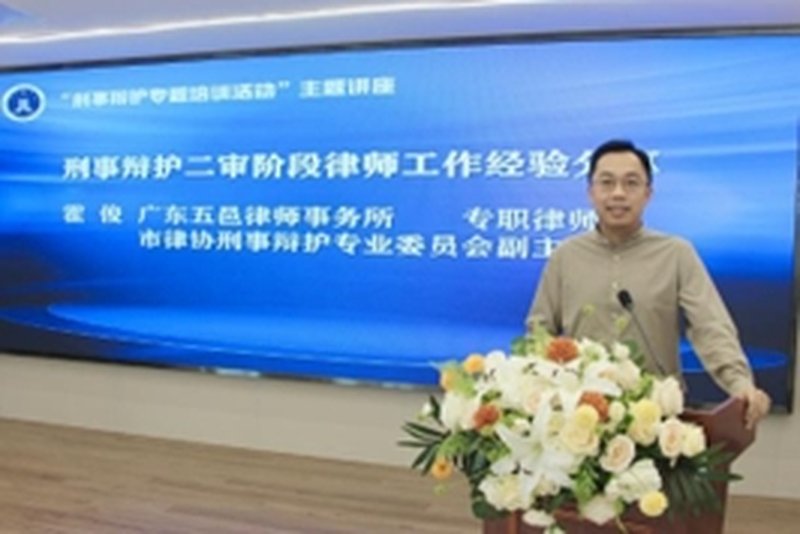
The training was chaired by Li Yingzi, Director of the association's Criminal Defense Professional Committee. Lawyer Zhong Chen and Lawyer Huo Jun, both Deputy Directors of the committee, served as keynote speakers. They analyzed practice, shared experience, and highlighted risks around the core stages of criminal defense, delivering content that was both practical and instructive, helping lawyers improve case quality and efficiency while holding to their professional bottom line.
Opening Remarks: Setting the Direction and Consolidating Responsibility
At the outset of the event, Director Li Yingzi delivered the opening remarks, introducing the background and objectives of the training. She emphasized the important role of criminal defense in safeguarding the lawful rights and interests of clients and promoting judicial fairness, and encouraged the participating lawyers to deepen their expertise, strictly observe professional standards, and handle every criminal case well with solid skills, thereby advancing the high-quality development of criminal defense work in Jiangmen.
Topic One: The Full Process of First-Instance Defense — Balancing Standards and Risk Control
Lawyer Zhong Chen, on the theme of key points and risk prevention for lawyers during the first-instance stage of criminal defense, systematically broke down the full-process practical operations of the first instance, drawing on real cases and hands-on experience:
● Meeting skills: how to effectively meet with the client, obtain key information, and build a relationship of trust; ● Case review strategy: how to systematically review case files, analyze evidence, and identify breakthroughs before trial; ● Key points of cross-examination: how to effectively challenge the prosecution's evidence during trial; ● Defense opinions: how to construct logically rigorous and persuasive defense arguments; ● Practice risks: common practice risk points at the first-instance stage and recommendations for prevention and control.
Drawing on case analyses, Lawyer Zhong explained the key considerations at each stage of first-instance defense in a clear and accessible manner, helping young lawyers establish a systematic framework for criminal defense thinking.
Topic Two: Key Points of Second-Instance Defense Practice — Breaking Conventions and Improving Success Rates
Lawyer Huo Jun, on the theme of key points and risk prevention for lawyers during the second-instance stage of criminal defense, focused on the distinctive features and core strategies of second-instance defense:
● Appeal strategy: how to analyze the scope for appeal based on the first-instance judgment and formulate a precise appeal strategy; ● Collection of new evidence: methods and precautions for discovering and utilizing new evidence in the second instance; ● Procedural defense: making full use of procedural defects to obtain favorable outcomes for the client; ● Communication with the procuratorate: how to communicate effectively during second-instance proceedings to encourage the procuratorate to file a protest or support the defense's position; ● Common misconceptions in second-instance practice: clarifying frequent misunderstandings to avoid letting cognitive biases undermine the effectiveness of the defense.
Drawing on practical cases, Lawyer Huo shared new ideas and methods for second-instance defense, helping lawyers break through the limits of conventional thinking and improve the success rate of second-instance defense.
Closing Remarks: Building Consensus and Promoting Development Together
At the close of the training, Zhao Jianke, Vice President of the association, delivered concluding remarks. He fully affirmed the professionalism and practicality of the training and expressed the hope that all lawyers would apply what they learned, putting their acquired skills into actual case work and continuously improving their criminal defense competence.
Participating lawyers expressed that the training was closely tied to practice and directly addressed pain points, both consolidating their professional foundation and clarifying risk boundaries, providing strong support for conducting criminal defense work in a standardized manner in the future.
This specialized criminal defense training was a practical initiative by the Criminal Defense Committee of the Jiangmen Lawyers Association to focus on lawyers' needs and empower professional growth. In the future, the committee will continue to build high-quality platforms for exchange and learning, regularly conduct activities such as practical training and experience sharing, and drive Jiangmen's criminal defense practice toward greater professionalism, standardization, and efficiency, contributing lawyers' strength to the building of a Jiangmen under the rule of law!
Source: Jiangmen Lawyers Association
※ This article is general legal information, not legal advice on any specific matter. For your individual case, please consult a lawyer.
← All articles